
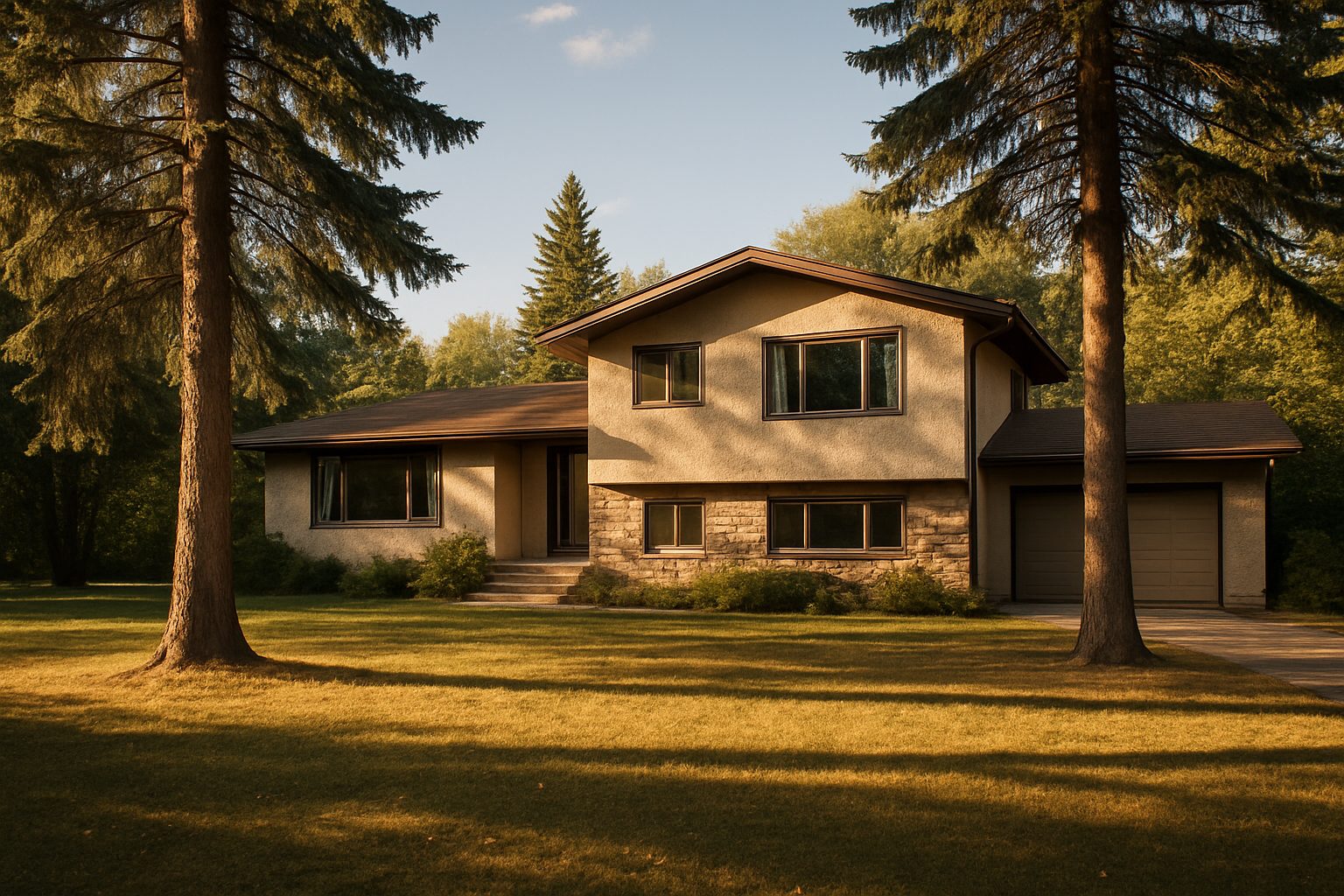
Stucco Repair in Charleswood
Large lots, mature trees and a housing stock built mostly between the 1950s and the 1980s, on ground that was farmland within living memory.
Charleswood is Winnipeg’s low-density corner: big lots, mature trees, and houses set well back. Winnipeg Stucco Works repairs stucco throughout the area.
Farmland Within Living Memory
This was agricultural land far later than most of Winnipeg. Before the war Charleswood was dairy and poultry farms, market gardens supplying the city, and mink ranches. As late as 1946 there were fewer than a hundred houses in Varsity View, which was still mostly forest and fields.
It incorporated as its own rural municipality in 1913, separating from Assiniboia, and by the 1930s was calling itself “The Suburb Beautiful.” It stayed a separate municipality until Unicity absorbed it in January 1972.
The building came later and fast. Most Charleswood houses date from the 1950s through the 1980s, with the bulk in the 1970s and 1980s. More than seven thousand five hundred homes went up in the 1970s alone. Varsity View added around 390 houses between 1971 and 1980, about a third of its total.
Roblin Park is the exception and the oldest of the post-war developments: a Veterans Land Act subdivision of 160 acres opened in 1945, first residents in 1946, with veterans borrowing up to $6,000 to build. Many were owner-built, so construction is less uniform than a developer subdivision.
Trees, Clay and Uneven Movement
Charleswood’s mature tree cover is one of its best features and a genuine factor in foundation movement.
A large tree draws a great deal of water out of the ground through a dry summer. Clay soil that loses moisture shrinks. When that shrinkage happens on one side of a house and not the other, the foundation moves unevenly, and uneven movement is what cracks a rigid finish like stucco.
It is a common pattern here: cracking noticeably worse on the elevation nearest the largest trees. Nothing needs to be done about the trees, but it explains the pattern and it affects how a repair is detailed.
Newer Builds
RidgeWood West and the other recent developments are a different proposition. Those walls have not been through enough cycles for seasonal cracking, so calls there are usually impact damage, a failed detail, or a finish being refreshed.
Typical work in Charleswood: stucco repair, stucco crack repair where movement is the cause, and stucco painting or stucco resurfacing on walls that are sound but dated.
Neighbourhoods We Serve in Charleswood
- Roblin Park
- Varsity View
- Marlton
- Westdale
- RidgeWood West
Our Services in Charleswood
- Stucco Repair in Charleswood
- Stucco Crack Repair in Charleswood
- Re-Stucco & Full Replacement in Charleswood
- New Stucco Installation in Charleswood
- Stucco Patching & Small Repairs in Charleswood
- Stucco Painting in Charleswood
- Parging Repair in Charleswood
- Parging in Charleswood
- Foundation & Chimney Parging in Charleswood
- Acrylic Stucco in Charleswood
- Cement Stucco in Charleswood
- EIFS & Synthetic Stucco in Charleswood
- Stucco Removal in Charleswood
- Stucco Resurfacing & Texture Matching in Charleswood
- Commercial Stucco in Charleswood
- Plaster Repair in Charleswood
Stucco Questions in Charleswood
How far west do you go?
To the Perimeter. That covers Roblin Park, Varsity View, Marlton, Westdale and the newer RidgeWood West development, everything between the Assiniboine and Wilkes.
My house is in Roblin Park. What is different about those homes?
Roblin Park was a Veterans Land Act subdivision, 160 acres opened in 1945 with the first residents arriving in 1946. Veterans could borrow up to $6,000 to build, and many of the houses were owner-built to modest plans. Construction varies more than in a developer-built subdivision, so we assess rather than assume.
Do the big trees affect the house?
They can. Mature trees draw significant moisture out of clay soil in a dry summer, and soil that dries and shrinks unevenly around a foundation moves the house unevenly with it. Where cracking is worse on the treed side of a house, that is often why.
Are newer Charleswood homes a different job?
Yes. RidgeWood West and the later builds are young enough that we are usually looking at isolated damage or a finish being refreshed, rather than the seasonal cracking that comes with sixty years of movement.
Serving Charleswood and Nearby
Stucco repair, parging and painting across Charleswood. Free written quote before we start.